What is a roofing estimate spreadsheet?
A roofing estimate spreadsheet is a workbook that uses roof measurements, material costs, labor rates, waste, pitch, adders, fees, and margin targets to calculate a customer proposal price.
Roofing estimating resource
A roofing estimate spreadsheet should turn roof measurements, material choices, labor, waste, pitch, adders, fees, tax assumptions, and target margin into a clear price before the proposal goes to the homeowner. The spreadsheet is not just a place to type numbers. It is the part of the estimate process where expensive guesswork either gets caught or quietly walks out the door.
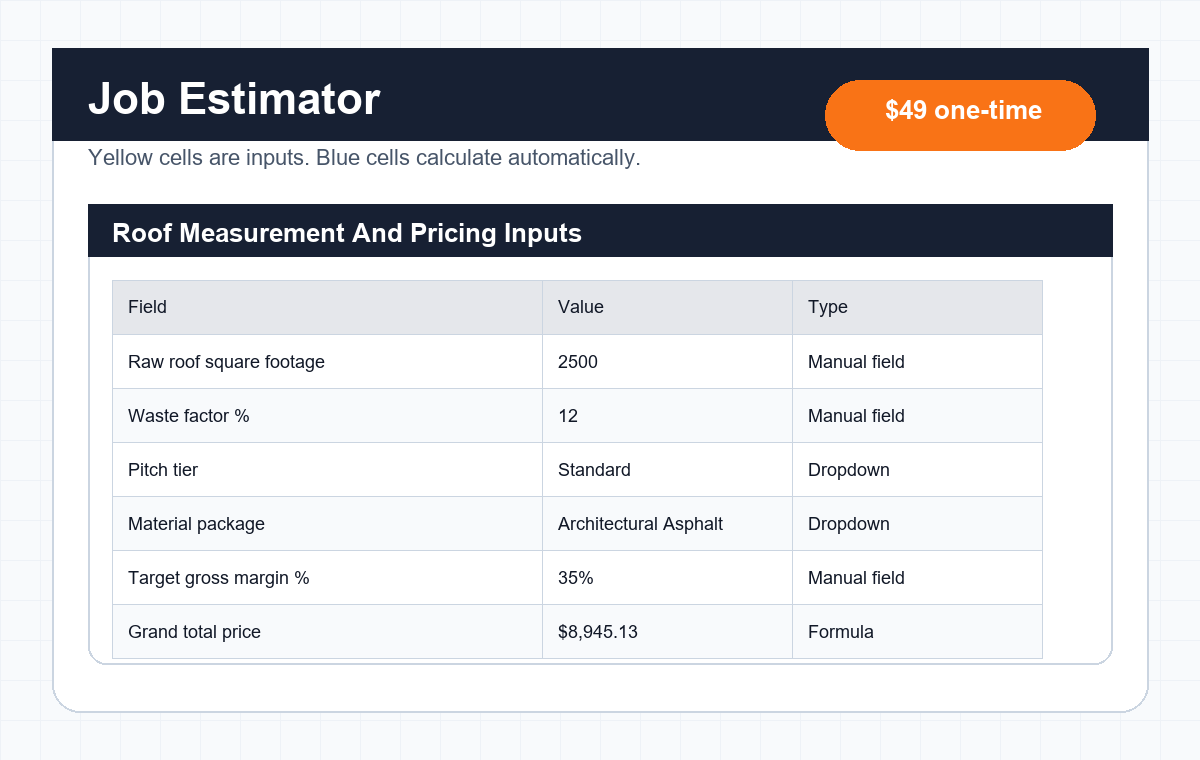
| Spreadsheet area | What it should handle | Why it matters |
|---|---|---|
| Roof measurements | Raw roof square footage, measured squares, waste percentage, and billable squares. | Material orders usually depend on roofing squares, not just raw square footage. |
| Cost matrix | Material package costs, labor rates, pitch multipliers, permit fees, disposal, and default terms. | If the base costs are wrong, the final estimate is just wrong with cleaner formatting. |
| Job estimator | Pitch tier, tear-off layers, ridge or hip cap, flashing, drip edge, adders, and target margin. | This is where the real job details turn into a price. |
| Client proposal | Scope, total price, deposit, assumptions, change-order notes, and approval fields. | The homeowner needs a clean proposal, not your raw cost math. |
Working spreadsheet
The Premium Roofing Estimating & Proposal Suite gives you the editable workbook: settings matrix, job estimator, formula map, and client proposal tab in one ZIP.

A blank estimate template can work for a small repair when the scope is simple and the numbers are already clear. It is not enough when the job has waste, pitch, tear-off layers, linear adders, disposal, permits, and margin all pulling on the final price at the same time.
A roofing estimate spreadsheet gives those details a place to live. The estimator does not have to remember every line item from memory while the phone rings and the next homeowner waits for a callback. The sheet becomes a checklist with math attached.
Clear beats clever here. A beautiful proposal with bad math is still bad math. It just wears a nicer jacket.
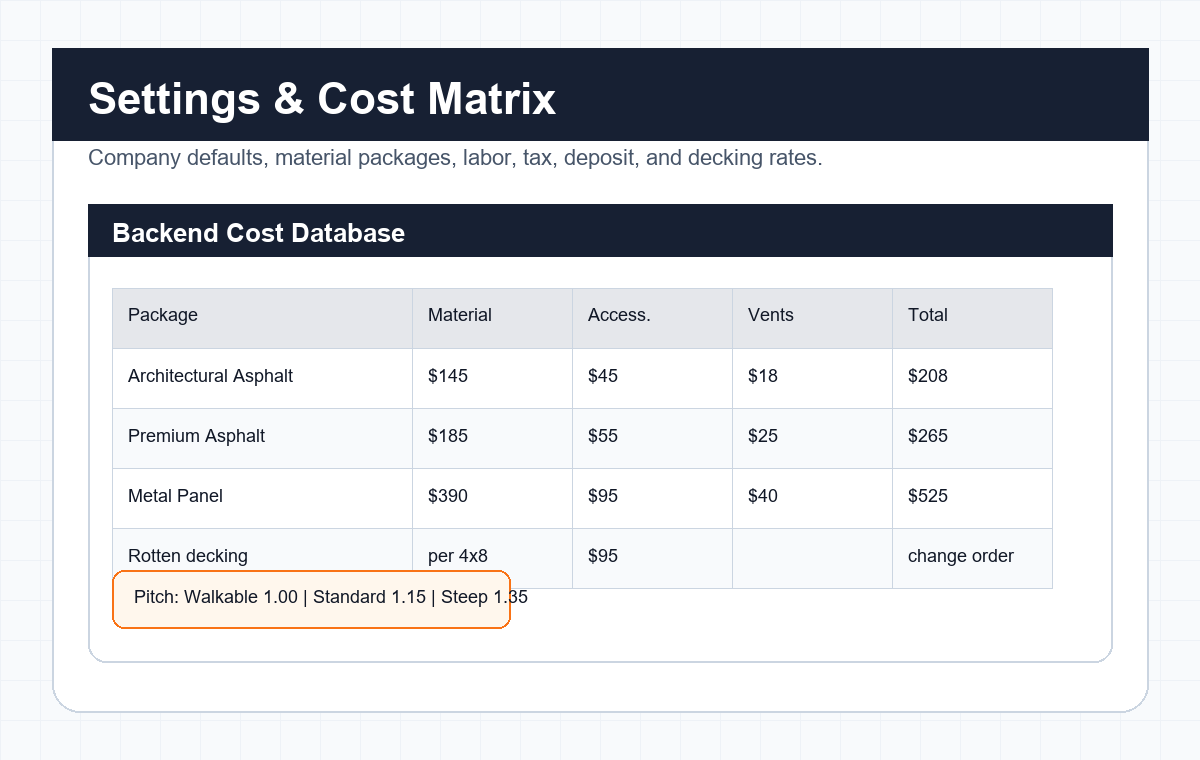
The cleanest roofing estimate spreadsheet separates setup data, active job inputs, and the customer-facing proposal. That keeps the raw cost work away from the document the homeowner sees.
| Tab | Who uses it | What it does |
|---|---|---|
| Settings & Cost Matrix | Owner or manager | Stores company details, material packages, labor rates, pitch multipliers, sales tax assumptions, deposit percentage, and default terms. |
| Job Estimator | Estimator, owner, or office admin | Collects the job-specific measurements and calculates material subtotal, labor, adders, subtotal cost, gross margin price, profit, and price per square. |
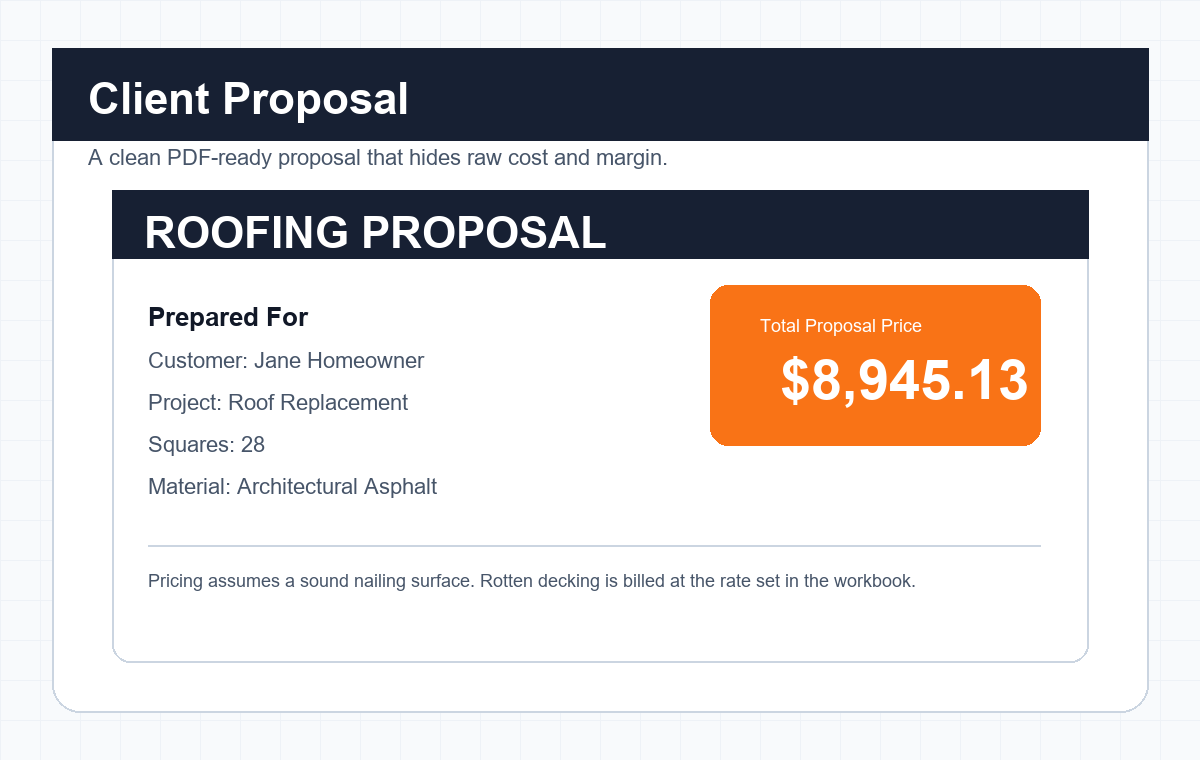
| Client Proposal | Customer-facing | Pulls only the clean proposal details: customer info, project summary, scope, total price, deposit, notes, and approval fields. |
The estimator tab is the working area. Inputs should be obvious, formula cells should be protected, and the sheet should make missing details feel uncomfortable before the proposal goes out.
A roofing estimate calculator spreadsheet does not need to be fancy. It needs to do a few important calculations correctly and consistently.
| Formula area | Plain-English formula | What to watch |
|---|---|---|
| Measured squares | Raw roof square footage / 100 | Roofing materials are commonly priced by the square, so the sheet needs this conversion early. |
| Billable squares with waste | ROUNDUP((Measured squares x (1 + Waste %)), 0) | Rounding down is how a spreadsheet starts acting brave with somebody else's material order. |
| Pitch multiplier | Look up the selected pitch tier and return the labor multiplier. | Apply pitch difficulty to labor lines where slope matters, not to permits, disposal, or every cost in sight. |
| True gross margin price | Subtotal costs / (1 - Target gross margin %) | This is not the same as adding a markup percentage to cost. |
| Deposit due | Grand total price x Deposit due % | Deposit rules and norms vary, so the percentage should be reviewed for your area and job type. |
Searchers use these terms like they are identical. They are close, but each one points to a different job inside the estimate process.
| Search phrase | What the roofer usually needs | Best page or file format |
|---|---|---|
| Roofing estimate spreadsheet | A working file with tabs, formulas, inputs, cost assumptions, margin math, and proposal output. | A multi-tab workbook with protected formula cells and a client proposal tab. |
| Roofing estimate calculator spreadsheet | A calculation engine that turns square footage, waste, pitch, material package, labor, and adders into a price. | A job estimator tab connected to a settings matrix. |
| Roofing cost estimate spreadsheet | A clearer way to track internal costs before deciding what the homeowner should see. | A workbook that separates raw costs, margin targets, and customer-facing copy. |
| Roofing estimate template | A repeatable document structure for customer details, scope, price, terms, and approval. | A written estimate or proposal layout, often supported by a spreadsheet behind it. |
| Roofing proposal spreadsheet | A file that calculates the estimate and feeds the customer proposal without exposing internal cost math. | A spreadsheet with a dedicated proposal tab for PDF export. |
This is where roofing estimates get sneaky. Markup and margin sound close enough that people use them like twins. They are not twins. They are more like cousins who argue at family events.
Markup adds a percentage on top of cost. Gross margin looks at what percentage of the final selling price remains after costs. If a job costs $10,000 and you add a 35% markup, the price is $13,500. But if you need a 35% gross margin, the price is $10,000 / (1 - 0.35), which equals $15,384.62.
That is a $1,884.62 difference on one example job. The point is not that every roofer needs the same margin. The point is that the spreadsheet should calculate the number you actually mean.
A good roofing proposal spreadsheet knows when to stop talking. The homeowner needs clarity. They do not need every raw supplier cost, crew rate, and margin target inside your business.
| Internal spreadsheet tabs | Client proposal tab |
|---|---|
| Supplier material costs, labor rates, pitch multipliers, tax assumptions, gross margin target, projected profit, and raw formula logic. | Company details, project address, roof summary, selected material package, scope of work, total price, deposit, assumptions, exclusions, and approval fields. |
| Detailed cost controls that help the business price the job. | Plain proposal details that help the homeowner understand what is included. |

Most spreadsheet problems are not dramatic at first. They sit quietly in the file until the estimate gets accepted. Then the quiet problem gets a truck, a crew, and a material order.
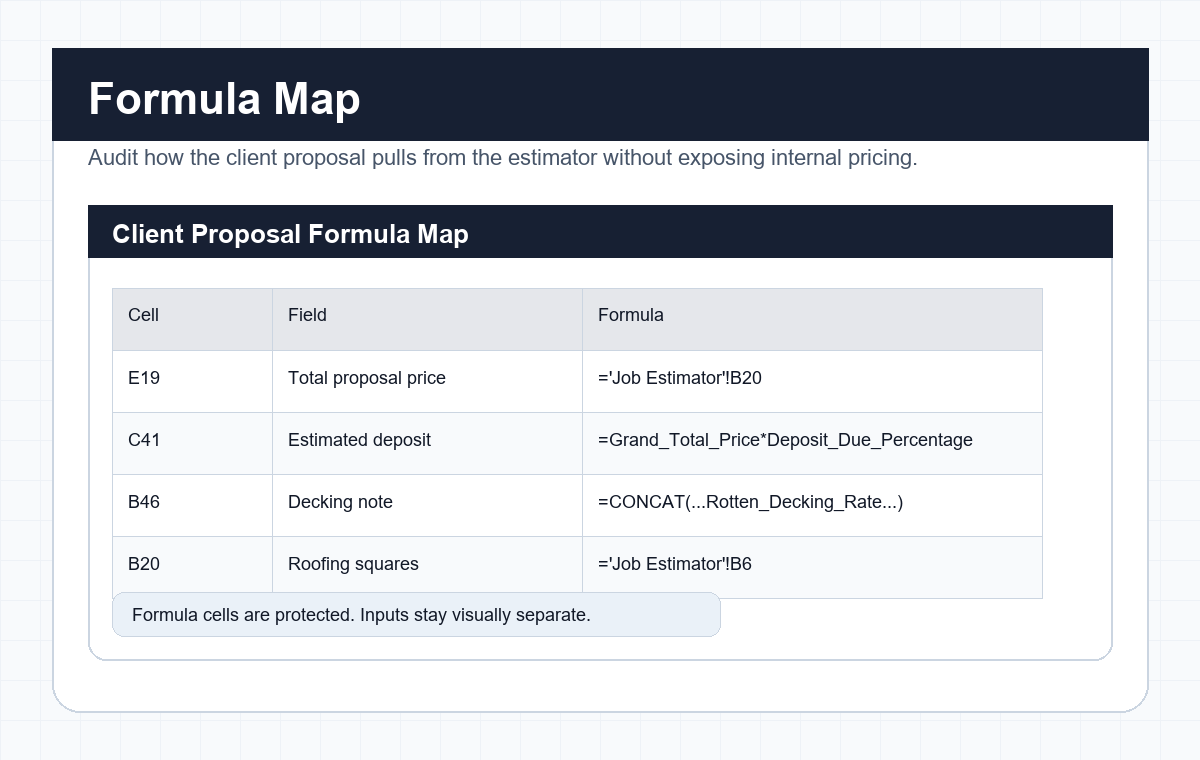
Excel is strong when you want an offline XLSX file, tighter file control, protected cells, and a workbook that can live on a field laptop without depending on a signal. That matters when the estimator is trying to work somewhere the internet has decided to take a lunch break.
Google Sheets is strong when several people need access to the same estimating file, especially if an office admin, owner, and salesperson all need to review numbers. The tradeoff is that imported Excel files should be checked carefully after upload.
If you move a roofing estimate excel spreadsheet into Google Sheets, test the lookups, dropdowns, protected ranges, formulas, and proposal formatting before trusting it with a real job.
The roofing estimate spreadsheet is the working hub. The other estimate pages answer different parts of the same job, which helps a roofer move from raw measurements to a customer-ready document without mixing up the purpose of each file.
| Resource | Job it handles | When to use it |
|---|---|---|
| Roofing estimate template | The general customer-facing estimate structure. | Use it when you need the basic fields: customer details, project address, scope, price, terms, and approval. |
| Roofing estimate Excel template | The offline XLSX version with protected formulas and print setup. | Use it when the estimator needs a native file on a laptop or tablet without trusting the jobsite signal. |
| Roofing quote template | The fixed-price document after the scope is clear. | Use it when the homeowner needs a firm price, expiration date, payment terms, and signature block. |
| Roofing proposal template | The sales presentation layer around the price. | Use it when you want to explain options, proof, warranty details, and why the company is worth choosing. |
| Roof estimate sample | The completed example that shows the numbers in context. | Use it when you want to see how a 30-square job turns into line items and a final proposal price. |
If one page is going to move from search impression to useful buyer traffic, this is the checklist it needs to answer. The spreadsheet has to prove it can survive real estimating work, not just look tidy in a screenshot.
| Audit question | What to check | Why it matters |
|---|---|---|
| Can the estimator find the input cells fast? | Manual entry cells should be visually different from formula cells. | A busy estimator should not have to poke around the workbook like they are defusing a tiny accounting bomb. |
| Does the sheet separate measured squares from billable squares? | Measured roof area, waste, and rounded material quantity should each have their own place. | This keeps the estimate from hiding waste inside a vague final number. |
| Does pitch affect only the right cost lines? | Pitch multipliers should apply to slope-sensitive labor, not permit fees, disposal, or every material line. | A steep roof should not magically make the city permit more expensive. |
| Can the final price be checked quickly? | Subtotal cost, target gross margin, projected profit, and price per square should be visible internally. | The owner needs to see whether the number makes sense before the customer sees it. |
| Can the proposal be exported cleanly? | The customer-facing tab should show scope, price, terms, deposit, assumptions, and approval without raw cost math. | The homeowner needs clarity, not the whole back office. |
A spreadsheet is useful for standard residential replacements, small repair pricing, and teams that need a cleaner estimate-to-proposal workflow. It is not a full roofing CRM, production system, legal contract package, or insurance estimating platform.
Large commercial work, insurance-heavy jobs, complex financing terms, public bids, multi-crew scheduling, and detailed production tracking may need dedicated software or professional review. A spreadsheet can support the pricing process, but it should not pretend to be the whole business.
Use the spreadsheet for what it is good at: organizing costs, calculations, proposal details, and the awkward little assumptions that make estimates go sideways when nobody writes them down.
A roofing estimate spreadsheet is a workbook that uses roof measurements, material costs, labor rates, waste, pitch, adders, fees, and margin targets to calculate a customer proposal price.
Yes. Excel works well for roofing estimates because it supports formulas, multiple tabs, dropdowns, protected cells, and offline XLSX files. The workbook should still be reviewed before it is used on live customer jobs.
Useful formulas include square footage to roofing squares, waste factor rounding, material subtotal, pitch labor multiplier, labor and disposal costs, true gross margin pricing, deposit due, and price per square.
Internally, yes. The estimator or owner should be able to review projected margin. On the client-facing proposal, no. The customer usually needs scope, price, terms, assumptions, and approval details, not raw margin math.
Markup adds a percentage to cost. Gross margin is the percentage of the final selling price left after costs. A 35% markup is not the same as a 35% gross margin.
Yes. The clean way is to use a separate client proposal tab that pulls customer details, project summary, final price, deposit, scope, notes, and signature fields from the estimator tab.
Not exactly. An Excel roofing calculator is usually the calculation part of the file. A roofing estimate spreadsheet can include that calculator, plus settings, job inputs, quote fields, proposal output, notes, and file controls.
Yes. A roofing estimate template is usually the document structure the customer can read. A roofing estimate spreadsheet is the working calculator behind the price, with formulas for measurements, waste, costs, labor, margin, and proposal output.
It should avoid mixing input cells with formula cells, hiding waste math, applying pitch multipliers to the wrong costs, using markup when the company means gross margin, and sending raw internal costs to the homeowner by accident.
Learn what a roofing estimate template should include, how it differs from a roofing quote template, and what to check before sending a roof estimate.
Roofing Estimate Form: What to Collect Before You Price the JobLearn what a roofing estimate form should collect before pricing a job, including customer details, roof measurements, scope notes, exclusions, payment terms, and worksheet fields.
Roofing Estimate Excel Template: What an Offline XLSX File Should IncludeLearn what a roofing estimate Excel template should include for offline estimating, protected formulas, PDF proposal export, and field-ready roofing quotes.
Roofing Quote Template: What to Include Before a Homeowner SignsLearn what a roofing quote template should include, including fixed scope, quote terms, payment schedule, expiration date, change orders, and customer approval.
Roofing Proposal Template: How to Present the Job Before the Homeowner SignsLearn what a roofing proposal template should include, including project story, trust signals, Good/Better/Best options, execution plan, terms, and sign-off.
Roof Estimate Sample: A Completed Roofing Estimate ExampleReview a completed roof estimate sample with 30-square project inputs, waste math, line items, true margin pricing, and the homeowner proposal view.
Disclaimer: This is a spreadsheet and estimating workflow resource, not legal, tax, accounting, insurance, or construction advice. Review formulas, material costs, labor rates, tax treatment, deposit rules, contract terms, local requirements, and proposal language before sending anything to a customer.