What is a roofing estimate form?
A roofing estimate form is an intake document that collects the customer, project, roof measurement, condition, scope, terms, and next-step details needed before a roof estimate is priced or sent.
Roofing estimating resource
A roofing estimate form should collect the facts that make a roof price possible: customer details, project address, roof measurements, pitch, access, layers, visible condition notes, material choice, scope, exclusions, payment terms, and next step. The form is not the final price. It is the jobsite and office worksheet that keeps the estimate from turning into guesswork.

| Form area | Fields to collect | Why it matters |
|---|---|---|
| Customer details | Name, phone, email, project address, billing address if different, and preferred contact method. | The office needs a clean handoff after the roof is measured. |
| Roof measurements | Measured square footage, measured squares, pitch, stories, access notes, and roof sections included. | The worksheet needs numbers before the spreadsheet can price anything useful. |
| Existing roof condition | Material type, number of layers, visible leaks, decking concerns, flashing notes, ventilation notes, and photos. | The visible condition tells the estimator where the quote may need guardrails. |
| Scope and options | Repair or replacement, material package, upgrade lines, tear-off scope, cleanup, disposal, and warranty path. | The customer-facing estimate should not have to guess what the form forgot. |
| Terms and next step | Expiration date, deposit assumption, payment terms, exclusions, change-order note, and approval action. | The form should lead to a clear proposal, not another round of vague email tennis. |
Working spreadsheet
The Premium Roofing Estimating & Proposal Suite gives you the editable workbook: settings matrix, job estimator, formula map, and client proposal tab in one ZIP.

A roofing estimate form is the intake layer. It is the place where a roofer, estimator, sales rep, or office admin captures the details that will later become a price, quote, worksheet, or proposal.
That matters because most estimate problems start before the math. The roof square footage is missing. The pitch note is vague. The customer wants the detached garage included, but nobody wrote that down. The office is now trying to price the job from a half-memory and a photo that looks like it was taken while escaping a rain cloud.
A good form slows the process down just enough to catch the expensive details. It does not need to be fancy. It needs to be hard to misunderstand.
People use roofing estimate form, roof estimate form, roof estimate worksheet, and roofing estimate sheet like they are the same thing. They overlap, but they should not do the same job.
| Document | Best use | What it should not do |
|---|---|---|
| Roofing estimate form | Collect customer, roof, condition, scope, and approval details before pricing. | It should not pretend every field is a final price. |
| Roof estimate worksheet | Work through measurements, waste, materials, labor, adders, and margin. | It should not be sent to the homeowner with raw internal costs by accident. |
| Roofing estimate sheet | Hold the working numbers inside Excel or Google Sheets. | It should not mix safe input fields with fragile formula cells. |
| Customer estimate or proposal | Show the final scope, price, terms, and next step clearly. | It should not expose every private cost assumption unless that is intentional. |
The first part of the form should be boring on purpose. Boring details are the ones that keep the file from getting lost later.

This is where the form becomes useful. Without measurement fields, the estimate turns into a polite guess with company branding.
| Field | What to capture | Estimator note |
|---|---|---|
| Measured square footage | Roof surface area from field measurement, aerial report, or takeoff. | Keep the source clear so the number can be checked later. |
| Measured squares | Square footage divided by 100. | This is before waste and rounding. |
| Waste factor | Common allowance such as 10%, 12%, 15%, or a job-specific value. | Cut-up roofs, valleys, hips, and material type can change this. |
| Pitch tier | Walkable, standard, steep, or a more specific slope note. | Pitch should affect the labor lines where slope actually matters. |
| Tear-off layers | Number of existing roofing layers to remove. | One extra layer can change labor, disposal, and schedule. |
| Linear adders | Ridge, hip, valley, flashing, drip edge, and special detail lengths. | These are easy to forget when the form only asks for total squares. |
Vague is not professional. Vague just makes the customer guess.
A roofing estimate form needs room for visible condition notes: missing shingles, soft-looking decking areas, leaking valleys, old flashing, ventilation concerns, ponding areas, damaged fascia, skylights, chimneys, satellite mounts, and anything else that may affect the work.
The form does not need to diagnose what cannot be seen. It should simply name what was visible and what may change after tear-off. That is how a form protects the estimate from pretending the roof is cleaner than it is.
The form should collect enough scope detail so the final estimate can explain the work without turning into a wall of roofing shorthand.
| Scope area | Form prompt | Why it helps |
|---|---|---|
| Tear-off | Remove existing material down to decking, overlay, repair-only, or partial section? | The customer should know what is happening to the old roof. |
| Decking | Assume sound decking, include replacement allowance, or quote per-sheet change order? | Hidden wood damage is one of the easiest places for confusion to grow teeth. |
| Underlayment and barriers | Synthetic underlayment, felt, ice and water shield, valleys, eaves, or code-specific areas. | These details help explain why two roof prices may not include the same system. |
| Flashing and penetrations | Chimneys, walls, skylights, pipe boots, vents, valleys, and custom metal notes. | Small roof details can become large customer questions. |
| Cleanup and disposal | Dumpster, dump fees, magnetic sweep, debris removal, and site cleanup expectations. | Cleanup is part of the customer experience, not an afterthought. |
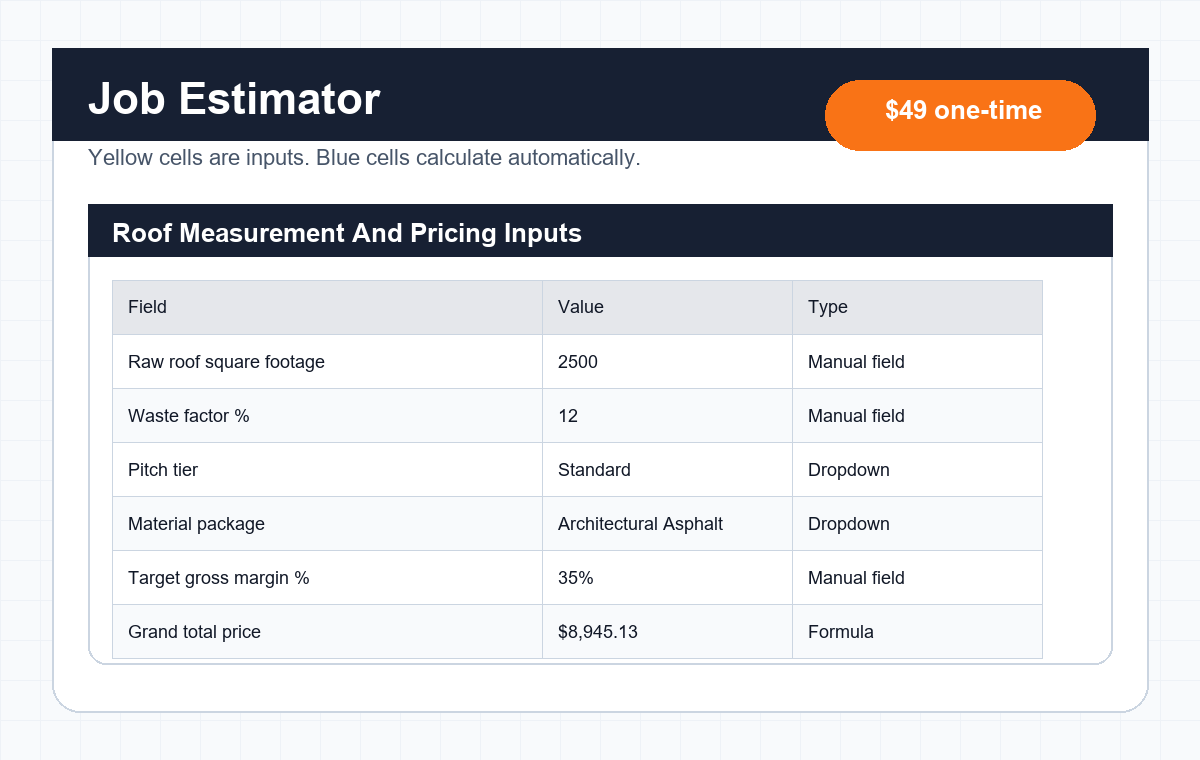
A roof estimate worksheet gets much stronger when the form fields match the spreadsheet inputs. If the workbook asks for square footage, waste, pitch, tear-off layers, material package, ridge footage, valley footage, permit fees, and target margin, the form should collect those same items.
That is the clean handoff: the estimator collects the roof facts, the spreadsheet calculates the internal price, and the proposal turns the reviewed result into something a homeowner can actually read.
When those pieces do not match, the office ends up translating the same job three times. That is how mistakes slip in wearing work boots.
Some form fields should survive into the final estimate or proposal because the homeowner needs them to understand the offer.
A form can collect internal pricing details without handing every cost lever to the customer.
A roofing estimate form is not enough when the job needs a full contract, insurance supplement, engineering review, financing disclosure, manufacturer warranty paperwork, or commercial bid package.
It is also not enough if the estimator skips the actual roof details and fills it out from memory. A blank form is not a system. A completed form with real measurements, notes, photos, and scope details is the thing that can help the next step.
Use the form to collect the facts. Use the worksheet to calculate the numbers. Use the proposal or quote to explain the reviewed offer.
Use this as the quick audit before an estimate goes out.
| Check | Question to ask | Pass/fail signal |
|---|---|---|
| Customer details | Can the office contact the right person without digging through texts? | Name, phone, email, and address are complete. |
| Roof details | Can another estimator understand what was measured? | Square footage, pitch, layers, roof areas, and source notes are clear. |
| Scope | Can the homeowner tell what is included? | Tear-off, installation, flashing, cleanup, disposal, and exclusions are named. |
| Math handoff | Can the spreadsheet calculate from the form without guessing? | All required worksheet inputs are present. |
| Next step | Does the customer know what to do after reading the estimate? | Approval, call, reply, or revision path is written clearly. |
A roofing estimate form is an intake document that collects the customer, project, roof measurement, condition, scope, terms, and next-step details needed before a roof estimate is priced or sent.
It should include customer details, project address, roof square footage, pitch, number of layers, visible condition notes, material choice, scope of work, exclusions, cleanup, disposal, payment terms, estimate expiration, and approval instructions.
Yes. The form collects job details. The worksheet usually handles the working math, such as squares, waste, materials, labor, adders, fees, and margin. The final estimate or proposal should be cleaner than the internal worksheet.
It can include pricing fields, but the safest workflow is to collect job details first, calculate the price in a worksheet or estimating tool, then review the customer-facing price before sending.
Yes, but the fields should change by job type. A small repair may need leak location, affected area, and access notes. A replacement needs measurements, tear-off scope, material package, waste, disposal, and proposal terms.
Usually not. Internal material costs, labor assumptions, target margin, and projected profit should stay inside the worksheet unless your business intentionally uses open-book pricing.
Learn what a roofing estimate template should include, how it differs from a roofing quote template, and what to check before sending a roof estimate.
Roofing Estimate Spreadsheet: What It Should Include Before You Price a JobLearn what a roofing estimate spreadsheet should include, including roofing squares, waste, pitch, labor, adders, gross margin, and client proposal output.
Roofing Estimate Excel Template: What an Offline XLSX File Should IncludeLearn what a roofing estimate Excel template should include for offline estimating, protected formulas, PDF proposal export, and field-ready roofing quotes.
Roofing Quote Template: What to Include Before a Homeowner SignsLearn what a roofing quote template should include, including fixed scope, quote terms, payment schedule, expiration date, change orders, and customer approval.
Roofing Proposal Template: How to Present the Job Before the Homeowner SignsLearn what a roofing proposal template should include, including project story, trust signals, Good/Better/Best options, execution plan, terms, and sign-off.
Roof Estimate Sample: A Completed Roofing Estimate ExampleReview a completed roof estimate sample with 30-square project inputs, waste math, line items, true margin pricing, and the homeowner proposal view.
Federal consumer guidance on written estimates, contracts, contractor details, down payments, and final payment.
CSLB: Learn about home improvement contractsCalifornia contractor board guidance showing why scope, price, and change-order details should be specific.
Mass.gov: Required home improvement contract termsState guidance showing how detailed home improvement paperwork requirements can become.
Disclaimer: This is a workflow and drafting resource, not legal, tax, accounting, insurance, pricing, or construction advice. Review local contract rules, permit requirements, deposit limits, warranty wording, insurance requirements, and job-specific conditions before using any estimate form with customers.